In Estación Carrillo, in the municipality of Jiménez, near the Zone of Silence, Lupita Hinojos discovered an ancient dinosaur fossil site on land she inherited from her family. The site contains 12 nearly complete petrified specimens. One of these has already been donated to the municipal government for display, while specialists from the National Autonomous University of Mexico (UNAM) are analyzing its age and species. Meanwhile, the owner plans to open a community museum in her home, located on the side of the highway toward Coahuila.
Between the borders of Chihuahua and Coahuila lies the ejido (communal land) of Laguna de Palomas, which belongs to the municipality of Jiménez. Within its boundaries are several villages whose inhabitants possess a rich history and enduring legacy, such as the communities of Las Glorias, La Soledad, Estación Carrillo, and Los Arenales, among others that continue to bring their traditions to life. The Hinojos family resides in these last two locations, where for years they have dedicated themselves to the area’s main activity: salt production. However, one of them decided to explore the land, which led him to discover a dinosaur fossil site. Part of his collection is already on display at the regional museum located in the former military barracks.
Guadalupe Hinojos, daughter of the man who found the fossil site, explained that it is located on the Los Arenales ranch, where bones that could be dinosaurs are still buried. She detailed that, after the search efforts, they have managed to extract hundreds of pieces, although many remain buried, waiting to be discovered. Among the pieces recovered are what appear to be reptile heads, parts of vertebrae, teeth, and a coprolite, which is being kept under extra security for fear that it might crumble or be lost.
In this regard, Mayor Francisco Muñoz Velázquez reported that he instructed Antonio Trujillo, Director of Tourism, to provide ongoing support to the case and to Guadalupe Hinojos. The goal is to provide her with legal and scientific certainty by connecting her with the National Institute of Anthropology and History (INAH) to register all the pieces, so that she can obtain legal title as custodian of these skeletal remains.

The Hinojos Family: Decades in the Search for Fossils in the Desert
Jesús Manuel Hinojos Urquidi began the search after inheriting land in the region known as Los Arenales, within the same district where, according to his daughter Guadalupe, he found stones that were different from those in the surrounding area. Upon extracting them, he began to study them and take them to experts, who agreed that it was not a simple matter; Therefore, he continued investigating the area and found more pieces with the same characteristics, which, according to Guadalupe Hinojos, are petrified fossils corresponding to the anatomy of dinosaurs that inhabited the area near the Tethys Sea millions of years ago.
In her account, she emphasized that she and her father walked through Los Arenales in search of these pre-Hispanic treasures, gradually amassing an extensive collection. They now possess hundreds of pieces awaiting identification to determine the type of animal, the body part, and the corresponding era. She stated that she maintains communication with the INAH (National Institute of Anthropology and History), an institution aware of the situation and carrying out the process to register the pieces, thus providing scientific support for the information provided by the Hinojos family.
The story of how this collection of pre-Hispanic bones was obtained centers on the interest of Jesús Manuel, who is said to have had a great passion for science-related topics. He had the knowledge to treat these kinds of high-value objects, so once he discovered the site, he put his knowledge to the test by cleaning each bone with precision and care to avoid damaging them; thanks to this, the findings remain intact and preserved to this day.
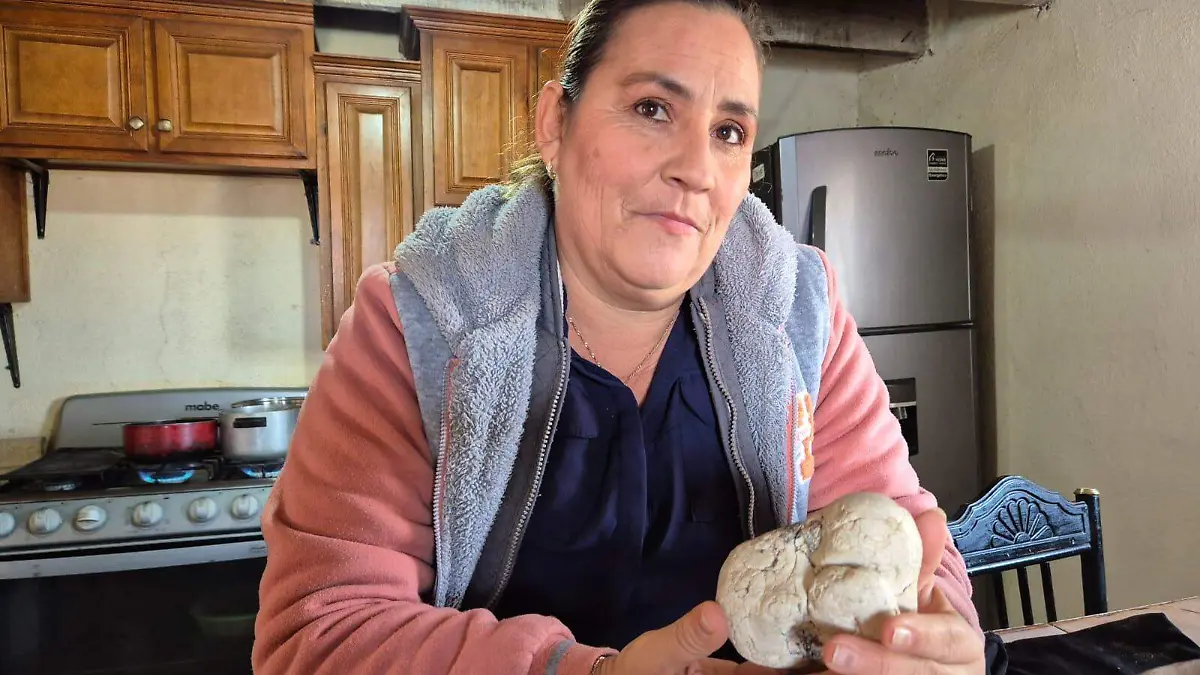
Guadalupe Hinojos, also known as Lupita, explained that this discovery occurred at the end of the 20th century when her father collected the artifacts and took them to Jiménez to seek advice; however, she noted that the government at the time offered no assistance. “Perhaps they thought it was a lie or a hoax, we don’t know why they didn’t help us,” she said. Her interest in continuing the investigation did not waver, so her request reached the Presidential Residence (Casa de los Pinos) in 2007, during the administration of former President Felipe Calderón, who ignored the request, arguing that there were not enough INAH (National Institute of Anthropology and History) personnel to travel to that location in northern Mexico. Therefore, without government support, the Chihuahua native continued collecting and preserving each piece at the ranch.
In 2024, Jesús Manuel Hinojos passed away due to health complications, leaving a legacy to his family and the community of Estación Carrillo. However, the story continues, as his daughter revived her father’s project and found in the administration of Francisco Muñoz Velázquez the support that had been denied him for decades; currently, the case is being documented by the INAH (National Institute of Anthropology and History). “An anthropologist already knew about the case years ago when my father requested help, but I didn’t know him, and now that I asked for help again, I ran into him,” she recounted. It is worth noting that this specialist is Jorge Carrera, the current director of the INAH delegation in Chihuahua.
Source: oem