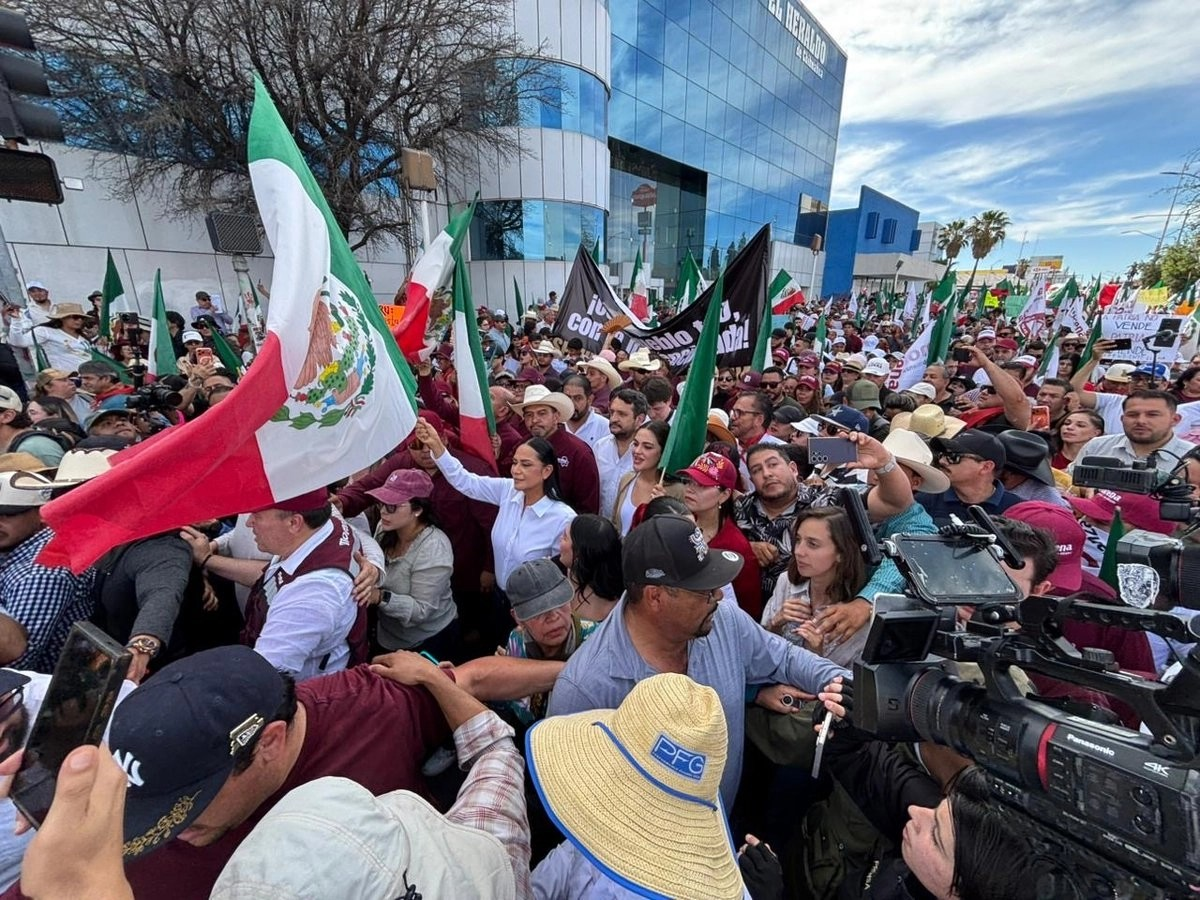

If the debate regarding events in Chihuahua centers on whether the “March for Security and Sovereignty”—convened by Morena on Saturday the 16th—was a success or a failure, it misses the mark entirely. Although the demonstration was the most heavily attended event the party has ever held in the state, the organizers would have wished for a larger turnout, while the “Prian” government would have preferred fewer attendees.
Beyond the march itself, one undeniable fact remains: indignation is brewing across various social sectors over the violation of national sovereignty perpetrated by the state government—specifically, its acceptance of CIA agents’ participation in various operations without adhering to legal requirements, and its granting of access to the physical premises and data of the Torre Centinela (Sentinel Tower) to U.S. agencies such as the DEA, FBI, and ICE. The first demonstration—which was not organized by Morena—took place on Monday, May 4th; subsequently, the Frente por la Defensa de la Soberanía (Front for the Defense of Sovereignty) began to take shape across several municipalities within the state. The march and rally held over the weekend followed thereafter.
The fundamental demand of these sectors is that the violation of sovereignty perpetrated by María Eugenia Campos’s administration not go unpunished, and that it be penalized in accordance with the law—regardless of the number of people who take to the streets or the hundreds of thousands of signatures collected to demand the impeachment of the state’s chief executive.
It is not merely sovereignty that has been violated: the state government—operating under the misguided belief that undermining the march would serve to downplay its own collusion with the CIA—has, since May 15th, undertaken various actions infringing upon individual civil liberties. These actions included setting up roadblocks at multiple points along major highways—staffed, in some instances, by public officials—to prevent people from reaching the march; suspending public transportation services in the state capital; and digging trenches along the planned route of the demonstration. At these highway checkpoints, individuals were required to produce identification and were explicitly informed that, if they hailed from the southern regions of the country, they had no right to participate in a protest against the governor. The situation even escalated to the point where journalist Israel Beltrán Silva was physically injured for asserting his right to freedom of movement. The government operation was accompanied by an extensive propaganda campaign highlighting the governor’s fight against drugs, denouncing the “Morena narco-governments,” dismissing accusations of treason against the nation, and—with racist and classist undertones—emphasizing the “resilient, hardworking, and free spirit of the people of Chihuahua” in contrast to centralism and “Southerners.” The state government squandered funds on digital portals, banners, and billboards—in addition to the 1.6 billion pesos it has spent co-opting news media outlets and paying for bot farms to insult anyone who dares to criticize its governor.

Putting an end to this impunity is an urgent imperative, for in Chihuahua there exists an undeniable interventionist project that extends far beyond the issue of drug trafficking: the aim is to sow the seeds of destabilization and cultivate a power structure parallel to the 4T. This project reaches beyond Trump and the 2027 elections. It serves as the spearhead for controlling supply chains, securing access to natural resources, monopolizing the drug trade, and constructing a political alternative—one malleable to transnational corporate interests—within a key border state.
For this reason, the 4T government and Morena must bear in mind that winning the 2027 elections will not suffice unless they address the deep-seated demands and grievances of various sectors within the region. Foremost among these are the demands of Indigenous peoples—as articulated by Patricia Castillo, a Rarámuri woman, during her opening remarks at a rally: “For the Rarámuri people—for our Indigenous communities—losing our territory to violence and State negligence amounts to robbing us of our history; it means falling ill with sorrow, far removed from our pine trees… from our very roots. Maru Campos’s administration has proven incapable of halting the destruction of our forests through logging, leaving the defenders of the Sierra completely isolated—their lives slowly extinguished amidst the indifference of the authorities.” One must also add the inadequacy of health services in the Sierra region, forced displacement in various municipalities, the dispossession of territories, the imposition of mining and tourism projects, and the extractive exploitation of nature.
The “4T” and Morena must recognize that the needs of Chihuahua’s farmers must be addressed: implementing programs such as Producción, Fertilizantes para el Bienestar, and Sembrando Vida with regional-specific criteria; bringing order to the bean and corn markets; addressing water and energy issues within the agricultural sector; and reactivating rural credit. There is a deep weariness stemming from the rigid, blanket homogenization of federal public policies, the acute lack of resources in institutions such as the IMSS, the presence of corrupt officials across all political parties, and public insecurity that shows no signs of abating.
What is at stake in Chihuahua goes beyond winning the 2027 elections. It is about putting an end to corruption and addressing the legitimate demands of the population in all its diversity. It is about demonstrating that the famous “second floor” of the 4T entails opening up and attending to regional specificities. The sovereignty of the whole is built from its parts.

Source: jornada