

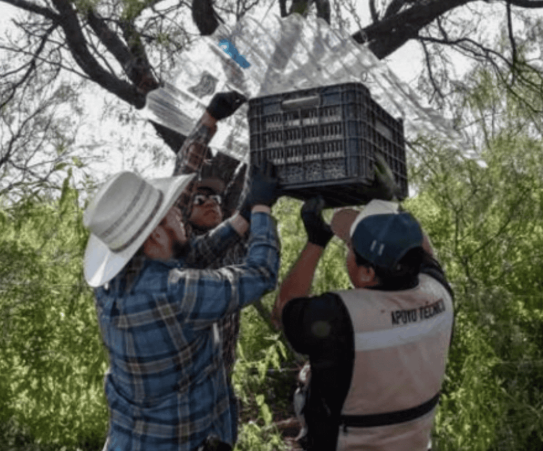

From July 27 to August 11, 14.97 million sterile flies were released in seven municipalities in Chihuahua to control and move toward the eradication of the New World screwworm (NWS). In addition, efforts have been strengthened to train producers, respond to cases in the field, and ensure the safe movement of animals.
The Ministry of Agriculture and Rural Development (Agricultura) reported that the technical team responsible for releasing sterile flies has installed 54 ground-based dispersal chambers at strategic locations in the municipalities of Coronado, Rosales, Valle de Allende, Cuauhtémoc, Aldama, Chínipas, and Bachíniva.
Government actions to control the screwworm
On July 13, the National Service for Agro-Alimentary Public Health, Safety and Quality (Senasica) confirmed the first NWS case in Hidalgo del Parral. Since then, authorities have implemented field operations, epidemiological surveillance, control and monitoring measures, as well as the release of sterile flies.
“At the same time, the Chihuahua Secretariat of Rural Development (SDR) and local livestock associations deployed teams of between 10 and 15 people in each affected municipality, with the purpose of supporting the federal health authority in responding to cases and visiting properties surrounding confirmed cases to detect the presence of the pest at an early stage,” the agency stated.

As part of efforts to promote reporting and the prevention and treatment of wounds, the General Directorate of Animal Health of Senasica conducted 18 informational sessions, attended by a total of 575 people. Meanwhile, Senasica technical personnel visited 93 points of contact, including veterinary clinics and livestock associations, to promote the timely reporting of screwworm infestations in animals.
Details on the release of sterile flies in Chihuahua
“With the objective of strengthening the response to suspected NWS cases in the field, 10 veterinarians are currently deployed throughout the state of Chihuahua, and coordination efforts concerning wildlife have also been reinforced,” the agency said in a statement.
From July 27 to August 1, Senasica authorities coordinated and strengthened field strategies through working meetings and visits to livestock production facilities located in areas surrounding confirmed cases.
Senasica urged livestock producers and the general public to continuously monitor cattle, pets, and wildlife, treat wounds, and immediately report the presence of larvae or screwworm infestations through the telephone number 800 751 2100, WhatsApp at 55 3996 4462, or the email address [email protected].
On July 14, the first case of screwworm was confirmed in a calf in the municipality of Hidalgo del Parral, Chihuahua. State and federal authorities announced that a sanitary containment perimeter and biological control measures would be implemented to prevent the spread of the pest and protect local livestock production.
Impact of the pest on local livestock production
On July 24, the United States Department of Agriculture (USDA) announced the gradual reopening of imports of Mexican cattle after the screwworm outbreak affected hundreds of cattle and other animals in border and southern states.
The USDA proposed a gradual reopening depending on progress against the pest and explained that Sonora and Chihuahua are considered the Mexican states at lower risk regarding screwworm because of their “strong and well-established inspection programs” and their geographic distance from southern Mexico, where most cases are concentrated.
Source: elmanana


