
For some Indigenous authorities who participated in the first consultation session in Chihuahua regarding the proposed General Law on the Rights of Indigenous and Afro-Mexican Peoples, the main difficulties were learning about the content of the proposal, understanding it, discussing it, and relating it to the realities of their communities. The second and final consultation in the state will take place on Friday, August 21, in the municipal seat of Guachochi.
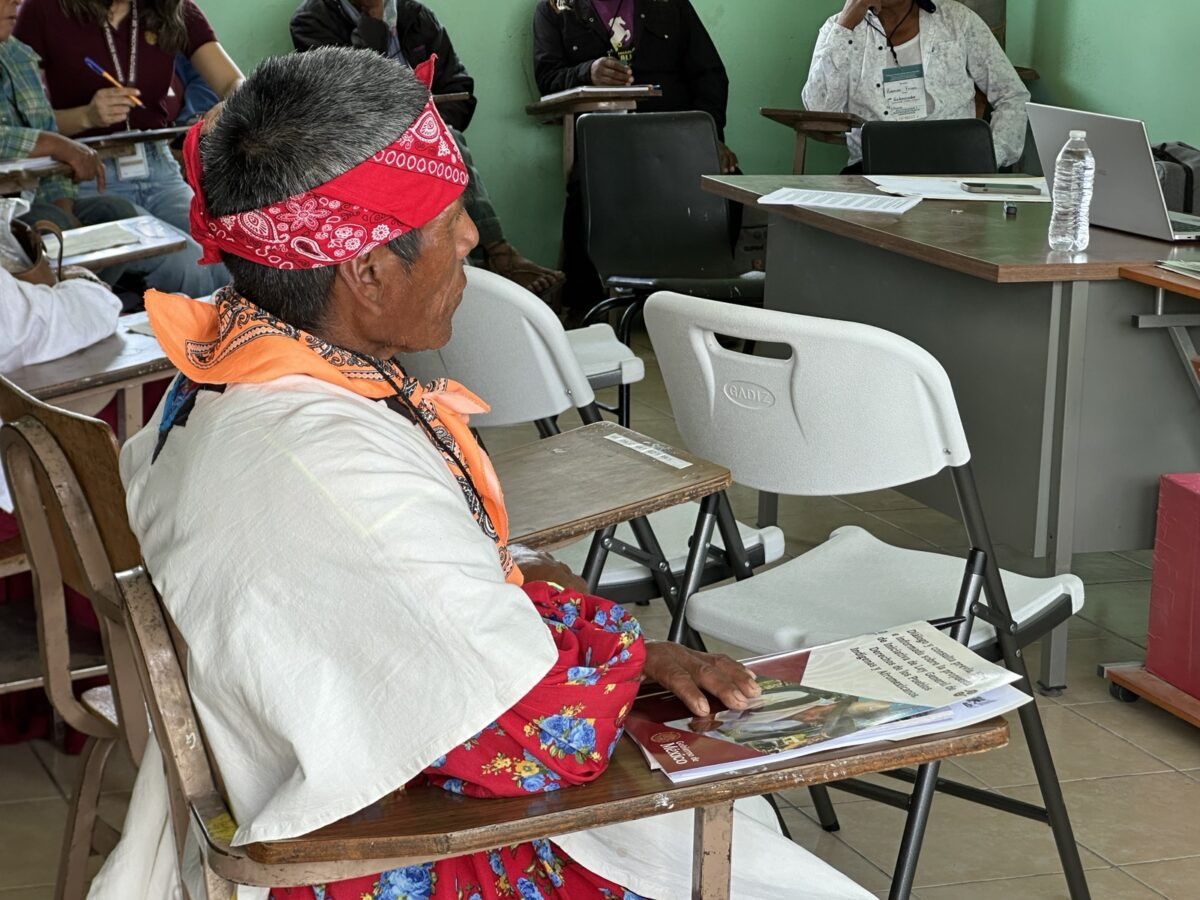
The initiative, consisting of 453 articles and 11 transitional articles, is contained in a 208-page booklet and is divided into eight books covering everything from the recognition of Indigenous peoples and communities as subjects of public law to self-determination and autonomy, the rights of Indigenous and Afro-Mexican women, children, adolescents and young people, free, prior and informed consultation and consent, as well as responsibilities, procedures, crimes, sanctions, and Indigenous and Afro-Mexican amparo proceedings.
However, for those who attended the working sessions, reviewing a document of this size during a consultation session represented a challenge.
“Many words we do not understand; we do not use them,” explained María del Rosario Casavantes, a Warijio governor from the community of Arechuyvo, in the municipality of Uruachi, who also participated in the technical committee that worked on developing the initiative. “So we get stuck there because we do not understand. If we do not ask questions, then we understand nothing.”

Casavantes pointed out that part of the difficulty was related to the terms used in the document and the need to ask questions whenever a concept was not understandable.
Benito Álvarez, Pima governor of the community of Mesa Blanca in the municipality of Madera, explained that part of the process has involved bringing the information to the communities and creating spaces where authorities can learn about the content of the proposal.
He recalled that they traveled to the community of Yepachi, in the municipality of Temósachi, where governors from different Pima communities in Madera and Temósachi, as well as members of the Rarámuri people, gathered to discuss the process.
However, Álvarez pointed out that legal content is not always easy to translate into the everyday language of the communities.
“The book contains many legal strategies and terms that we often do not understand,” he said. Therefore, he considered it necessary to consult with others and find ways to explain the content so that it can be understood according to the ways of speaking and understanding of each community.
Álvarez explained that, based on his experience, the proposal requires a process of explanation and training so that authorities can later convey the information to their communities.
“For me, explaining it to the community means that, up to now, we have to go and raise awareness among the communities. Because it is not easy to arrive and simply present a legal issue,” he said.
The Pima governor added that traditional authorities themselves need training and must attend assemblies in order to understand the content and subsequently convey it to their communities.
He also referred to the time available to participate in the meetings.
The consultation coincided with community responsibilities and productive activities. Álvarez explained that during planting season, authorities have commitments that make it difficult to leave their communities to attend meetings.
“The time is indeed limited. Right now, we all have our commitments and obligations in our communities.”
453 Articles and Little Time to Discuss Them

Miguel Manuel Parra, a member of the Mogótavo community and of the technical committee that participated in developing the initiative, knows the process from another position.
He explained that the construction of the proposal began years ago and that the technical committee consisted of Indigenous representatives and specialists.
During the sessions, he said, there were discussions and disagreements related to the content and scope of the proposal. “The task was to analyze all of that, and many times there were lengthy debates because they went into great detail, and it really is complicated,” he explained.
The committee’s work was not brief either. Parra recalled that they held seven sessions, some of which lasted from early in the morning until 10 or 11 at night. “It was very tiring,” he said.
The complexity does not disappear simply because people speak Spanish or have a profession. “It is complicated to understand in itself, even if they speak Spanish and even if they have a profession,” he said, referring to legislative terminology and the methods used to draft a law.
And the size of the proposal illustrates the scale of the challenge. There are 453 articles and 11 transitional provisions. Miguel Parra recalled that the version initially presented to the technical committee contained more than 500 articles and was later reduced.
Therefore, he considered that explaining the content in detail to a community requires much more time than what is available during an assembly.
“To do that, it would have to be an entire year of school, and no,” he warned.
The Journey Is Also Part of the Consultation
For María del Rosario Casavantes, Warijio governor of Arechuyvo, the problem is not limited to legal language.
Her community is approximately seven hours from the municipal seat and, according to her testimony, the road is in poor condition. The journey represents an additional difficulty in participating in these types of processes. “What we struggle with is getting out of my community; there is no car, there is no way for us to get around,” she explained.
Despite this, authorities have to leave their activities behind to attend and learn about what is being proposed. “We have to leave [our work] so that we can find out what it is about, what we are going to do, what is available so that we can request support for the community. So we make the effort and leave our work in our communities,” she said.
Distance, road conditions, transportation availability, and productive responsibilities thus become factors that directly affect the ability to participate in a consultation.
A Consultation That Must Also Reach Women

Dolores de Todos los Santos Vigil, a member of the San Ignacio de Arareco community, participated in the session related to the rights of Indigenous women.
From that perspective, she observed another difficulty: not all women in the communities are familiar with the rights addressed in the proposal. “I feel that perhaps not all of us are familiar with these rights of Indigenous women,” she explained.
Todos los Santos added that in some communities, these issues are still not discussed on a daily basis.
For her, the information should not be concentrated in communities located near service centers or municipal seats. There are communities located in the canyons where, she said, people still do not have sufficient knowledge about issues related to access to justice, healthcare, or education.
She considered that there was still not enough time during the Indigenous women’s rights session to fully address the information.
The scale of the content appears again in her testimony.
Vigil explained that even someone with experience in education would have difficulty reviewing the material completely in a single session. As an example, she said that she asked her daughter, who is a teacher, how long it might take her to work through one of the books in the proposal, and her response was that even an entire school year would not be enough to fully address its content.
“This cannot be done in one day,” she stated.
From her perspective, the information is too extensive to be reviewed “superficially” and requires the support of people capable of explaining the technical terms.
Interpreting Is Not Simply Translating Words
The language issue also arose during the working sessions.
Miguel Parra explained that interpretation into Rarámuri was available, although in his working group they decided to primarily use Spanish because the available Rarámuri variant corresponded to the Upper Tarahumara region, while the participants came from other municipalities.
Manuel Parra himself pointed out that there are variations within the language and that, although translation was available, some people may not understand certain expressions. He also indicated that there was a group of Warijio participants who speak their own language.
Todos los Santos Villalobos Vigil raised a similar concern based on her experience: the interpreter had little participation and, from her perspective, part of the problem was that the variant being used did not necessarily correspond to that of the communities in the central region.
“It is not the same way of understanding what comes from the central region,” she added.
For her, a consultation of this scale requires not only someone who can translate, but also an accompanying process that allows legal concepts to be explained while taking into account the linguistic variants used by the communities.
“It is like studying for a bachelor’s degree, a high school diploma, or whatever; yes, it would take at least three years of being in a school,” she said when describing the amount of information contained in the proposal.

“It Is Very Difficult; It Is Too Rushed”
Todos los Santos Villalobos considers that the limited time ultimately restricted the possibility of going deeper into the issues. “It is very difficult, it is too rushed, and above all, you want to contribute more, you want to say other things, but there is not enough time,” she complained.
Her participation in the Indigenous women’s session was not only to learn about the content. She also wanted to share knowledge and experiences with other women, but said there was not enough time to do so.
She would even have liked to participate in other sessions, particularly those related to territory and interpretation, due to her own experience as an interpreter. “I am an interpreter, but I see that the work of interpreters is not recognized,” she explained. However, the available time did not allow her to explore the issue in greater depth.
The INPI’s Information Strategy
In response to these difficulties, representatives of the National Institute of Indigenous Peoples explained that a strategy had been implemented to provide information to communities in advance.
Víctor Martínez, local director of the INPI in Chihuahua, explained that during the information stage, the eight books of the proposal were reviewed in general terms and invitations to the assemblies were distributed, along with a copy of the initiative, a booklet summarizing the proposal, the notice published in the Official Gazette of the Federation, and a document containing 20 points related to the consultation process.
He also stated that radio was used as part of the information strategy.
Materials about the process and the information stage were prepared in the languages in which the radio broadcasts, mainly Ódami, two Rarámuri variants, and Spanish, with the intention of keeping the consultation process present in the communities.
Martínez acknowledged that the content of the initiative is dense, but considered it important for communities to be able to learn about the articles, analyze them, and indicate what should be modified if they did not reflect their needs or aspirations.
“That they know every article, that they analyze it, and that they tell us what would need to be changed if that were the case, or whether that article reflects the feelings and wishes of the communities,” he stated.
The INPI director also acknowledged the difficulties involved in bringing information to remote communities.
Martínez gave the example of communities located a full day away by road, such as one in Cabeza de Viejo, in the municipality of Morelos, where communication can be difficult.
The official stated that they normally try to notify the most remote communities 15 to 20 days in advance, in addition to using various available means of communication, such as telephone, WhatsApp, or assistance from people who have access to these means.
Weather conditions also played a role, as Víctor Martínez stated that July was particularly rainy and that this affected the information stage.
434 Communities Visited
According to information published on the INPI website, 469 Indigenous communities have been identified in the state. For the information-delivery campaign carried out during July 2026, the institute reported that 434 communities had been visited and 35 remained pending.
According to a document shared by the INPI, 281 people attended and participated in the working sessions during the consultation process.
The consultation process involved community authorities and institutions at different levels.
Participants included traditional authorities, representatives of the INPI, the United Nations, Mexico’s Ministry of Women, the Supreme Court of Justice of the Nation, the Ministry of the Interior, the state Secretariat of Indigenous Peoples and Communities, municipal authorities, the Chihuahua State Congress, and representatives of peoples such as the Rarámuri, Warijio, and Pima.
The testimonies collected during the interviews show different experiences regarding the development of the consultation sessions, particularly concerning the time available, the language used, interpretation, and transportation conditions.
For Vidulfo Rosales Sierra, representing the Supreme Court of Justice of the Nation, the discussion also has a historical dimension. “For a long time, we have not had a law; Indigenous peoples have been legally nonexistent,” he stated.
He recalled that there are laws covering different areas, while Indigenous peoples have historically lacked legislation that fully recognizes their legal existence.
For the authorities and participants consulted, the challenge comes down to something more basic: having enough time to read and discuss the articles, having interpreters for the appropriate linguistic variants, overcoming transportation difficulties, and creating spaces where communities can ask questions and express disagreements without legal language becoming a barrier.

Source: laverdadjuarez